
Mededeling

Collapse
No announcement yet.

Wat is goede medi wiet?

Collapse
Dit is een Sticky topic.
X
X
 
  • Filter
  • Tijd
  • Geef Weer
Clear All
new posts

    Re: Wat is goede medi wiet?

    Graag gedaan.
    http://www.youtube.com/watch?v=zCvSc2b8CWc

    Comment


      Re: Wat is goede medi wiet?

      Heb het nou een paar keer gebruikt en het "rookt" heerlijk weg. Ook super handig met zo'n portable e-sigaret dingetje. Slaap er ook prima op.

      Laatst lekte er wel wat van die vloeistof uit de e-sigaret en kreeg het in mijn mond. Is die vloeistof nou gevaarlijk of is het gewoon glycerine ofzo?

      Lopen verslag: McPurple S1 Fem van Forum Genetics op DWC met GHE FloraNova onder 400W Cree COBs

      Comment


        Re: Wat is goede medi wiet?

        Mooi dat je er op kan slapen.

        De vloeistof is uiteraard niet giftig.
        Er zit ook geen nicotine in, wat wel heel giftig is bij directe inname.
        Ik doe er geen glycerine in, wat wel zou kunnen om wat zoetigheid toe te voegen.

        Ik ben wel aan het studeren op aroma's die niet schadelijk zijn.
        Bv een echte L- bosbessen aroma voor de Blueberry TT.

        Maar zolang ik niet zeker weet dat het geen kwaad kan, blijft mijn vloeistof naturel.
        http://www.youtube.com/watch?v=zCvSc2b8CWc

        Comment


          Re: Wat is goede medi wiet?

          oooh wat zou ik dat graag proberen die e-juice ik heb als hobby dampen en gebruik veel verschillende soorten mods en rebuildeble tanks ik maak ook mijn eigen sapjes om te dampen
          voor mijn pijn gebruik ik wiet op recept de bediol voor de pijn en bedica voor het slapen in combi met een acsent en davinci vaporizer
          maar wat zou dat top zijn om het in mijn kayfuns te kunnen doen das veel makkelijker
          ik heb nu van de week wel de stoute schoenen aangedaan en medische wiet zaadjes gekocht met stekbakje en voeding hopen dat dat lukt want heb het nog nooit gedaan
          en hjm mocht je het gaan verkopen of je geheim willen onthullen hoe ik er e juice van kan maken houd ik me aanbevolen

          Comment


            Re: Wat is goede medi wiet?

            Stuur maar een PM Christa
            http://www.youtube.com/watch?v=zCvSc2b8CWc

            Comment


              Re: Wat is goede medi wiet?

              hoe doe ik dat een pm sturen

              Comment


                Re: Wat is goede medi wiet?

                Comment


                  Re: Wat is goede medi wiet?

                  kan die link niet openen

                  Comment


                    Re: Wat is goede medi wiet?

                    Hoi crista ik lees net dat er problemen zijn met PM versturen. de crew is er mee bezig, morgen nog eens proberen.

                    Comment


                      Re: Wat is goede medi wiet?

                      top bedankt

                      Comment


                        Re: Wat is goede medi wiet?

                        hjm lukt het jou om mij een pm te sturen

                        Comment


                          Re: Wat is goede medi wiet?

                          xxxxxx

                          Dit bericht is samengevoegd wegens dubbelposting.

                          Nee
                          Je moet wat meer posten denk ik.
                          http://www.youtube.com/watch?v=zCvSc2b8CWc

                          Comment


                            Re: Wat is goede medi wiet?

                            zal ik doen kijken of dat helpt

                            Comment


                              Re: Wat is goede medi wiet?

                              Video Library
                              Make The Medicine
                              Producing The Highest-Quality Oil
                              What It Does & How It Works
                              Dosage Information
                              Testimonials
                              More in this section...Video LibraryMake The MedicineProducing The Highest-Quality OilWhat It Does & How It WorksDosage InformationTestimonialsMore in this section...Video LibraryMake The MedicineProducing The Highest-Quality OilWhat It Does & How It WorksDosage InformationTestimonialsMore in this section...Video LibraryMake The MedicineProducing The Highest-Quality OilWhat It Does & How It WorksDosage InformationTestimonials

                              The Rick Simpson Process of Producing Hemp Oil
                              “I usually work with a pound or more of bud from very potent high quality indica or indica dominant sativa crosses. An ounce of good bud will usually produce 3 to 4 grams of high-grade oil and the amount of oil produced will vary from strain to strain. You are never really sure how much oil you will get until you have processed the material you are working with. On average, a pound of good bud will usually produce about 60 grams of high-grade oil and sometimes you may even get substantially more from some varieties.
                              Many seem to believe the oil must be amber and that you should be able to see through it. Often the oils I produced did exhibit these traits but not always. The color and texture of the oil you are producing depends a great deal on the strain, method, and solvent that you are using to produce the oil. Don’t be concerned if the oil you produce happens to be darker in color, this does not mean that such an oil is not a potent medicine. Indeed some of the strongest oils I have ever produced were dark in color, but they still had the desired medicinal effects.
                              I think these instructions should make producing this oil quite easy for anyone, but before you start, make sure that you have everything you will need to do it properly. All one requires is the starting material, solvent, a length of wood, two plastic buckets, a few small containers with funnels and coffee filters, an electric rice cooker, a fan, a stainless steel measuring cup, a coffee warmer and syringes.
                              The process I am about to describe involves washing the starting material twice with a good solvent such as pure light aliphatic naphtha or 99% isopropyl alcohol to remove the available resin from the plant material. Light naphtha has proven itself to be a very good solvent to produce the oil, it is also quite cheap to purchase when compared to the cost of other solvents. It comes in different forms and under different names but the solvent I used is called light naphtha in Canada, and in Europe it is often called benzin(e). It is sold under many names but if you go to a fuel supplier, you should not have too much trouble tracking some down if you ask for hydrotreated light aliphatic solvent naphtha/petroleum ether/benzine/hydrocarbon solvent with a boiling point anywhere from 40 to 100°C (140 – 212°F), CAS number 64742-49-0.
                              Light naphtha has many industrial uses, and is often used to degrease engine parts or thin paints etc., so I’m sure you should have little trouble finding what you need. Just to give you an idea of its many uses, it is the same substance used to fuel Coleman lamps and stoves. But, unfortunately, rust inhibitors are added to Coleman fuel, so I do not recommend that this fuel be used to produce oil. There is also medical-grade naphtha (hexane) available in many countries in the world, but it is a bit more expensive and usually harder to get and I have not found any significant difference between pure light naphtha and the medical-grade version of it.
                              Butane can produce oil but I do not recommend its use as a solvent to produce this medication, since it is very volatile and would require the use of expensive equipment to neutralize the danger. In addition, using butane to produce the oil does not decarboxylate the finished product, so oils produced in this manner would be less effective for medicinal use, unless the extra time is taken to decarboxylate them properly.
                              The only solvents that I have direct experience with so far are ether, light aliphatic naphtha, and 99% isopropyl alcohol. Ether is my personal favorite and it is a very effective solvent but it is expensive and can be quite hard to get. I think the use of ether is better suited for closed distilling devices, since it is very volatile and its fumes make it dangerous to work with.
                              Both ether and light naphtha are more selective solvents in nature, which means alcohol is not quite as effective as a solvent but still it does work well. Alcohol will dissolve more chlorophyll from the starting material and due to this, oils produced with alcohol will usually be more noticeably dark in color.
                              For a solvent to be effective, it should be 100% pure and 100% pure alcohol is expensive and can be quite hard to find. Light naphtha on the other hand is quite cheap to acquire and is usually not too hard to locate. Next to the use of ether, pure light aliphatic naphtha is my solvent of choice.
                              All these solvents including alcohol are poisonous in nature but if you follow these instructions, solvent residue in the finished oil is not a concern. After the finished product cools to room temperature, it is a thick grease-like substance rather than an oil and it is about as anti-poisonous as you can get. Even if there was a slight trace of solvent residue remaining, the oil itself would act upon it to neutralize any harmful poisonous effect. In essence, all you are doing is washing the medicinal resins off the bud material. Then, after the solvent oil mix has been filtered and the solvent has been boiled off, you are left with the resins in their most medicinal form.
                              For best results, the starting material must be as dry as possible. Be sure where you are working is well ventilated and there are no sparks, open flames, or red-hot elements in the area.
                              Place the starting material in a container of good depth to prevent the oil solvent mix from splashing out during the washing process. Then, dampen the bud with the solvent being used and the bud material is then crushed using a length of wood such as a piece of 2×2.
                              After it has been crushed, add more solvent until the material is completely immersed in the solvent. Work the bud material for about three minutes with the length of wood you used to crush it. Then slowly pour the solvent oil mix off into another clean container, leaving the starting material in the original container, so it can be washed for the second time.
                              Again add fresh solvent to the starting material until it is once more immersed in the solvent, and then work it for three more minutes with the length of wood you have been using. Then, pour the solvent oil mix into the same container that is holding the solvent oil mix from the first wash you did.
                              Trying to do a third wash on the plant material produces very little oil and it would be of little or no benefit as a medicine. The first wash dissolves 70 to 80% of the available resin off the starting material; the second wash then removes whatever resin that is of benefit, which remains.
                              Oils produced from the first wash are the most potent medicinally but if high-grade starting material is used, oil from the second wash also has benefits. If, for some reason, you have to work with material that is not as potent as it should be, it is best to use the oil from the first wash only for internal use and then start to grow or look for starting material that is of better quality. Remember, quality is more important than quantity and the better the starting material, the better the medicine.
                              Use something such as clean water containers with a small opening at the top and insert funnels into the openings, then put large coffee filters in the funnels. Pour the solvent oil mix from the first and second washes into the coffee filters and allow the solvent oil mix to drain through the filters to remove any unwanted plant material. The more funnels and containers you use, the faster it will be filtered. Once the solvent oil mix has been filtered, it is now ready to have the solvent boiled off.
                              If you do not already own one, you can purchase an inexpensive larger rice cooker with an open top that has both high and low heat settings to boil the solvent off the oil. Make sure that the rice cooker is set up in a well-ventilated area and place a fan nearby to blow away the fumes as the solvent boils off. This will prevent the fumes from condensing and posing a danger. Rice cookers are designed not to burn the rice as it cooks. The temperature sensors that are built in will automatically switch the cooker back on the low heat setting if the temperature within the cooker begins to get too high.
                              When producing oil, if the temperature gets a little over 300°F (148°C), it will begin to vaporize the cannabinoids off the oil and, of course, you do not want this to occur. If a rice cooker is working properly, it will automatically come off the high heat setting at roughly 230°F (110°C), which is above the temperature where decarboxylation is said to occur and is still well below the point that THC and other cannabinoids will vaporize. This is why I strongly recommend the use of a rice cooker to those who have never produced oil before, since it eliminates any danger of harming the oil in question. Plus the resulting oil is decarboxylated, which is also important, so it can achieve its full medicinal effects.
                              I suggest that people should not try to use crock-pots and similar appliances to produce oil. When I first tried to produce the oil, I used a crock-pot and since I did not know how much heat these devices can generate, the oil overheated and was ruined. So I think it’s only sensible that a beginner should start out by using a rice cooker and follow our instructions carefully. Doing so could save them a lot of grief.
                              A distilling device can also be used to produce this medication and reclaim the solvent that is being used. This method really does make more sense than using a rice cooker, but stills that are designed to boil off solvents safely are expensive and most people do not know how to operate one of these devices properly. If one is available, I prefer to use a still myself, but, in some countries, owning a still is against the law. If one is serious and wants to produce large amounts of oil, look into distilling and educate yourself in the proper use of this equipment.
                              Always make sure there are no sparks, open flames, or red-hot elements in the area while you are filling the rice cooker or boiling the solvent off because the fumes produced from solvents are very flammable and toxic. I have used this same process thousands of times and have never had a mishap, but for your own safety, please follow the instructions and make sure the area is well ventilated. I also caution you to avoid breathing in the fumes that solvents produce since they can have unpleasant effects on anyone nearby.
                              Make sure that the fan is running and produces enough airflow to blow away the fumes, then fill the rice cooker until it is about three quarters full. This allows room for the solvent oil mix to boil off without spilling over. Put the rice cooker on its high heat setting and begin boiling the solvent off. Never attempt to do this without the use of a fan, since the fumes could condense and if they come in contact with the heating element, it might cause a fire.
                              As the level in the rice cooker drops, continue to carefully add the solvent oil mix you have remaining, until you have nothing left. When the level in the rice cooker comes down for the last time and has been reduced to about two inches of solvent oil mix remaining, add about 10 to 12 drops of water to the solvent oil mix that remains. This small amount of water allows the remaining solvent to boil off the oil that remains in the cooker more readily.
                              When there is very little remaining in the cooker, I usually put on a pair of gloves and then pick up the cooker and begin swirling its contents. This is done with the airflow from the fan still taking the fumes away and it can speed up the finishing process slightly. In a short time, the cooker automatically kicks off its high heat setting and then goes to low heat. As the last of the solvent is being boiled off, you will hear a crackling sound from the oil that is left in the cooker and you will see quite a bit of bubbling taking place in the oil that remains. Also, you will notice what looks like a small amount of smoke or steam coming off the oil in the rice cooker, but don’t be concerned, as this is mostly just steam produced from the few drops of water that you added. After the rice cooker has automatically switched to its low heat setting, I usually let it cool until it can be switched to the high heat setting again. After the cooker has automatically switched itself to the low heat setting for the second time, I then take the inner pot out of the cooker and pour its contents into a stainless steel measuring cup.
                              There will be a small amount of oil remaining in the pot that you will find almost impossible to get out, unless you use something like dry bread to absorb the oil, while it is still warm. Then, small amounts of this bread can be eaten as a medicine, but remember it can sometimes take an hour or more before you feel its effects. So be careful how much bread like this you consume, because even a very small amount may put you to sleep for quite a few hours just the same as the raw oil will do itself. Another good way to clean up whatever oil remains in the pot is to wash the pot out with a small amount of alcohol to produce a hemp oil tincture.
                              A tincture such as this can be very effective in the treatment of skin conditions and just a little can go a long way, which can save you money. Since I often like to mix oil from several strains anyway, I usually simply leave the remaining oil in the pot until next time. By mixing oils from different strains, you receive the medicinal benefits from all these different types of oil and I have found such oils to be effective in the treatment of everything. If you have many different varieties of good hemp at your disposal, I think mixing the oils is a good idea, but if you do not, I believe the oil from just one strain will probably satisfy your needs.
                              Take the oil that you poured into the stainless steel measuring cup and put it on a gentle heating device such as a coffee warmer to evaporate off whatever water remains in the oil. Quite often, it only takes a short time to evaporate the remaining water off, but also some strains produce more natural terpenes than others. These terpenes can cause the oil you now have on the coffee warmer to bubble for quite some time and it may take a while for such oils to cease this activity. When the oil on the coffee warmer has stopped bubbling and there is little or no activity visible, take the oil off the coffee warmer and allow it to cool a bit.
                              Another way to finish the oil without the use of a coffee warmer is to put the oil in an oven set at 130°C (266°F) for about an hour. Both of these methods will decarboxylate the finished oil and solvent residue should not be an issue.
                              Then, using plastic applicators or syringes with no needles that are available in your local drug store, use the plunger to slowly draw the warm oil up into the syringes and allow it to cool. In a short time, the resin will become a thick grease-like substance.
                              Sometimes the resin is so thick that it can be hard to force it out of the syringes when cooled. If such a thing happens, simply put the syringe in a cup of hot water in a short time you will be able to squeeze your dosage out more easily. Sometimes a patient will force out too much oil, but if this happens, just pull back on the plunger of the syringe and the excess oil can usually be drawn back into the syringe without too much difficulty.
                              On average, a dry pound of material will require about 2 gallons (8-9 liters) of solvent to do the two washes that are required. If you plan to produce the oil from more or less starting material, simply do the math to determine roughly how much solvent you will require. From start to finish, it usually takes three to four hours to accomplish the whole process, and then the medicine is sitting there ready to be used.
                              It should also be mentioned that this oil has an extremely long shelf life. But for long-term storage, I would put it in a dark bottle with a tight lid or a stainless steel container. If kept in a cool dark place when stored, it can maintain its medicinal potency for years.
                              At first, it may seem daunting for some to try to produce their own medicine but in reality, this process is extremely simple. All you have to do is carefully follow the instructions and after you produce this medication a couple of times, you will find that it is not much harder to make than a cup of coffee. Once you have produced your own medication, it takes all the mystery out of medicine and you no longer have to rely on doctors in most cases, for now you have become your own doctor.” Rick Simpson

                              Dit bericht is samengevoegd wegens dubbelposting.

                              Got cancer? Decarboxylate your Cannabis

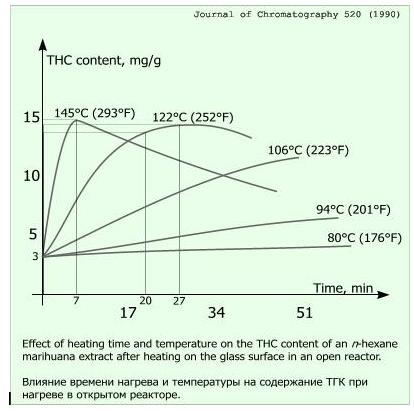
                              Decarboxylation is simply removing a carboxyl group (CO2+H) from the phytocannabinoid THCA to create the active THC, that will now fit the CB-1 receptor on certain cells. This process occurs simply through heating. You can use high heat for a short time, or medium heat for a longer time. High heat destroys much of the beneficial chemistry of the cannabinoids, terpinoids, and flavinoids. The optimum temperature is 240ºF. for 30-45 minutes. There is much opinion about the process, but this is a good place to start. As you see from the graph, the Russians were doing this over 20 years ago.
                              Essential to the success of this process is the preparation of the plant material previous to heating. The plant material must be really dry. Run it through a blender to break up the material. Remove stems. Lay it out on a cookie sheet. Preheat oven to 240º, heat for 30-45 minutes. Follow with extracting the oil.
                              It is possible to perform the decarboxylation either on the extract, or with the dry plant material. Either way will work.
                              Why decarboxylation? If we are fighting cancer, we need to optimize the potency of treatment. THC kills cancer by shredding the mitochondria to disrupt its energy metabolism, while leaving normal cells untouched. THCA will not have this effect.
                              ~ Dennis Hill


                              Dit bericht is samengevoegd wegens dubbelposting.


                              Zegt niet veel over de talloze hybriden, maar een hint voor de novice.

                              Dit bericht is samengevoegd wegens dubbelposting.


                              Dit bericht is samengevoegd wegens dubbelposting.

                              Decarboxylation graph
                              Another fly in the ointment, is that we can never know for sure exactly what the starting state of decarboxylation is, so the times at temperature shown on the graphs are an average.
                              We can’t expect dry material placed in an oven at any given temperature to be that uniform temperature throughout instantly upon placing it in a heated oven, nor know for sure the state of decarboxylation by simple observation.
                              Decarboxylating plant material, also alters the taste (roasted/toasted), which some find less agreeable, and of course decarboxylating also evaporates away the smaller Monoterpenes and Sequiterpenes alcohols, phenols, ketones, aldehydes, ethers, and esters.
                              The good news is that it is dirt simple to monitor the state of cannabis oil decarboxylation placed in a 121C/250F hot oil bath, because you can watch the CO2 bubble production.
                              Just like the curves suggest, CO2 bubble production will proceed at its own observable rate. By keeping the puddle of oil lightly stirred on the bottom and in the corners of the pot (I use a bamboo skewer), so as to keep the bubbles broken free and floating to the top, you can tell exactly when the bubble formation suddenly tapers off at the top of the curve.
                              That is the point that we take it out of the oil for maximum head effect, and we leave it in until all bubbling stops, if we want a more sedative night time med.
                              Here are a couple pictures of what oil looks like when boiling off the residual butane. Residual butane or alcohol produces larger, randomly sized bubbles, and is fully purged, when they cease.
                              I am seemingly missing the middle picture of the CO2 bubbles, so I will add it later, but the second picture shows what fully decarboxylated oil looks like.

                              Residual solvent bubbles above:
                              Quiescent oil.
                              http://www.youtube.com/watch?v=zCvSc2b8CWc

                              Comment


                                Re: Wat is goede medi wiet?

                                Maar kijk niet alleen naar wiet. Er zijn meer goede kruiden.
                                Ik heb zojuist uit China Salicin 25% en Huang Qin extract aan gekregen. Dat wordt dus weer capsules vullen.


                                Ook heb ik nog Cordiceps in bestelling daar.
                                De Cordyceps sinensis is een breed inzetbare paddenstoel
                                Dit artikel geeft op basis van recente reviews en experimentele in-vitro en dierstudies een goede indruk van de eigenschappen en mogelijke toepassingen van de bijzondere medicinale paddenstoel Cordyceps sinensis.

                                Cordyceps sinensis is een kostbare medicinale paddenstoel die in China en andere Aziatische landen al meer dan 2000 jaar als tonicum wordt gebruikt om de gezondheid en vitaliteit te verhogen, veroudering tegen te gaan en uiteenlopende (leeftijdsgerelateerde) ziektebeelden te behandelen.(1,2,3,12) Cordyceps wordt binnen de traditionele Chinese geneeskunde (TCM) onder meer ingezet om de ‘Nier’- en ‘Long’- meridiaan te versterken en vermoeidheid, nachtzweten, lage rugpijn, verminderd libido, impotentie, hyperglycemie, hyperlipidemie, uitputting door ernstige ziekte, luchtwegaandoeningen, hart- en vaatziekten, nierziekten en leverziekten te behandelen.(1-7,12) Cordyceps is sinds 1964 officieel geclassificeerd als geneesmiddel in de Chinese farmacopee.(2)

                                Winterworm en zomergras
                                Cordyceps parasiteert op de rups van een bepaalde soort nachtvlinders en wordt wel ‘winterworm’ (met mycelia gevulde rups) en ‘zomergras’ (vruchtlichaam uit rupsmummie) genoemd vanwege de verschillende verschijningsvormen. De met uitsterven bedreigde paddenstoel komt alleen in het hooggebergte (het Qinghai- Tibetaanse plateau) van Zuidwest-China en Tibet voor. Gelukkig kunnen mycelia van Cordyceps sinensis tegenwoordig uitstekend worden gekweekt op een plantaardige voedingsbodem zoals rijst.(1) Onderzoekers hebben vastgesteld dat mycelia van de hiervoor geselecteerde Cordyceps sinensisvariant dezelfde inhoudsstoffen bevatten en dezelfde farmacologische en medicinale eigenschappen bezitten als de oorspronkelijke, wilde Cordyceps.(1,8,9) Dit geldt eveneens voor (gekweekte) mycelia van Cordyceps militaris.(1,10)

                                Yin voedend en Yang versterkend
                                Cordyceps wordt in de TCM geclassificeerd als een tonicum dat het Yin voedt (Yin staat voor structuur) en het Yang versterkt (Yang staat voor functie).(5,6) De Yin tonifiërende kwaliteit van Cordyceps sinensis uit zich onder meer in de antioxidantactiviteit en de krachtige immunomodulerende werking. Cordyceps stimuleert en versterkt het afweersysteem wanneer dit verzwakt is of extra ondersteuning behoeft (infectieziekten, veroudering, kanker) en remt en reguleert het afweersysteem wanneer dit overactief is (chronische ontstekingsziekten) of uit balans is geraakt (stress, allergieën, autoimmuunziekten).(1,2,4,5,8,11-13) De Yang versterkende kwaliteit van Cordyceps uit zich onder meer in het verhogen van de cellulaire (mitochondriale) energieproductie, mede door het verminderen van oxidatieve stress en het verbeteren van de glucosestofwisseling.(5,11) Verschillende humane studies, waaronder een placebogecontroleerde studie met chronisch vermoeide ouderen, bevestigen dat Cordyceps de vitaliteit verhoogt.(12) Bij chronisch vermoeide ouderen namen klachten zoals vermoeidheid, koude intolerantie, duizeligheid, oorsuizen en geheugenproblemen vergeleken met de controlegroep significant af door het gebruik van Cordyceps.( 12) In een andere placebogecontroleerde studie met gezonde ouderen stegen uithoudingsvermogen en maximale zuurstofcapaciteit tijdens inspanning (fietsen op een hometrainer) significant na het gebruik van Cordyceps.(12)

                                Een simpele en betrouwbare methode om te kijken of een preparaat het uithoudingsvermogen verbetert en vermoeidheid remt, is een dierexperiment waarin muizen worden gedwongen te zwemmen tot ze volledig uitgeput zijn. In deze test zorgde suppletie met een (heet)waterextract van Cordyceps sinensis (rijk aan polysachariden) voor significante toename van het uithoudingsvermogen en afname van vermoeidheid, mede door het verbeteren van de stresstolerantie.(9,12) De acute stresssituatie leidde bij de controledieren tot vergroting van de bijnieren en verkleining van lever, milt, thymus en schildklier. Bij de dieren die het cordycepsextract kregen, had stress geen invloed op de omvang en het gewicht van deze organen.(9)

                                Cordyceps sinensis zorgt mede door verbetering van de energieproductie, antioxidantstatus, immunocompetentie en stressbestendigheid voor vertraging van het verouderingsproces.(5)

                                Seksualiteit en vruchtbaarheid
                                Cordyceps sinensis staat bekend als afrodisiacum dat de geslachtsdrift verhoogt bij zowel mannen als vrouwen, vooral als deze minder is geworden met de leeftijd. Dit komt mede doordat Cordyceps de biosynthese verbetert van steroïdhormonen (cortisol, testosteron, oestrogeen), waarvan de productie daalt met het ouder worden.(5,6,12,13) In een dierexperimenteel model voor (mannelijke) veroudering (geïnduceerd door castratie) is onlangs bevestigd dat deze Cordyceps sinensis een (dosisafhankelijke) libidoverhogende activiteit bezit.(7) In een eerder diermodel voor verminderde aanmaak van androgenen (bij de mens veroorzaakt door ziekte, veroudering of medicijngebruik) zorgde onbewerkte cordycepspoeder (20 mg per kilogram lichaamsgewicht) voor een sterkere verhoging van de testosteronspiegel dan verschillende cordycepsextracten.(15)

                                Van oudsher wordt Cordyceps gebruikt om de vruchtbaarheid van mannen en vrouwen te versterken. Wetenschappers denken dat Cordyceps een geschikte kandidaat is om de vruchtbaarheid bij vrouwen te verbeteren en de slagingskans van in-vitro fertilisatie (IVF) te verhogen. In-vitro onderzoek heeft uitgewezen dat Cordyceps sinensis de productie van 17β-oestradiol* door humane granulosaluteïnecellen (ovariumcellen) dosisafhankelijk stimuleert door upregulatie van de expressie van enzymen, met name StAR (steroidogenic acute regulatory protein) en aromatase.(14) Er is toenemend bewijs dat 17β-oestradiol een directe invloed heeft op de kwaliteit van uitrijpende eicellen en daarmee de uitkomst van een IVFbehandeling.

                                Stemming en cognitie
                                De kans op cognitieve achteruitgang en dementie neemt toe met het ouder worden. In een diermodel voor veroudering (geïnduceerd door D-galactose*) zorgde suppletie met Cordyceps sinensisextract voor significante, dosisafhankelijke verbetering van leren en geheugen. De onderzoekers zagen tevens een significante verhoging van de activiteit van antioxidantenzymen (glutathionperoxidase, superoxidedismutase, catalase), waarvan de activiteit was gedaald door het verouderingsproces.(7) De (ultra)structuur van de hippocampus, een hersengebied waarin degeneratieve veranderingen waren opgetreden, verbeterde sterk door suppletie met Cordyceps. Het onderzoek suggereert dat Cordyceps sinensis de hersenen (structureel en functioneel) gezond houdt bij het ouder worden, mede door het verbeteren van de antioxidantstatus.(7)

                                Aangezien vermoeidheid en depressie dicht bij elkaar liggen, wilden onderzoekers weten of Cordyceps sinensis een antidepressieve werking heeft. Zij vonden bevestiging voor deze hypothese in een veelgebruikt diermodel voor depressie (tail suspension test), waarin een cordycepsextract (verkregen door superkritische vloeistofextractie met CO2) een significante antidepressieve werking liet zien. De onderzoekers stelden vast dat de antidepressieve activiteit mede is gebaseerd op beïnvloeding van de adrenerge* en dopaminerge* systemen (en niet het serotonerge systeem).(11) Volgens de ‘monoamine hypothese’ spelen monoamines* (noradrenaline, dopamine, serotonine) een belangrijke rol bij het ontstaan van depressieve klachten.

                                Hart en bloedvaten
                                Cordyceps sinensis heeft een aantal eigenschappen die helpen verklaren dat de medicinale paddenstoel goed is voor hart en bloedvaten. Cordyceps heeft een vaatverwijdende en bloeddrukverlagende werking, ondersteunt een regelmatig hart ritme, verlaagt de cholesterolspiegel, remt de klontering van bloedplaatjes, heeft een ontstekingsremmende en antioxidatieve activiteit, remt ischemie-reperfusieschade* en verbetert de doorbloeding van de hartspier.(1,2,7,11,12,14,16) In een dierstudie had Cordyceps sinensis een genezende werking bij renale hypertensie.(1)

                                Proefdieren die naast een cholesterolrijk dieet een heetwaterextract van Cordyceps sinensis (mycelia) kregen, hadden een lagere totale cholesterolspiegel dan de controles.(18) Bovendien verbeterde de atherogene index (totaalcholesterol min HDL-cholesterol, gedeeld door HDL-cholesterol), mede door stijging van de HDLcholesterolspiegel en daling van de LDLen VLDL-cholesterolspiegels. De dierstudie suggereert dat het cordycepsextract atherosclerose tegengaat door verbetering van de bloedlipiden. In diverse humane studies is aangetoond dat het gebruik van Cordyceps (circa 3 gram per dag) leidt tot significante daling van de cholesterol- en triglyceridenspiegels, stijging van de HDLcholesterolspiegel en verbetering van de ratio tussen HDL- en LDL-cholesterol.(12)

                                Glucosestofwisseling
                                Talloze dierstudies hebben uitgewezen dat Cordyceps sinensis helpt bij het tegengaan van hyperglycemie (door diabetes type 1 of 2) en zorgt voor verbetering van de (perifere) insulinegevoeligheid.(11,14,19) Het zijn vermoedelijk polysachariden (met name β-glucanen) in Cordyceps sinensis die de bloedglucosespiegel verlagen. Mogelijke verklaringen voor de hypoglycemische activiteit van Cordyceps zijn: verbetering van de insuline-afgifte door de pancreas en/of remming van de insuline-afbraak; vermindering van oxidatieve stress; verhoging van glucoseregulerende enzymen in de lever (glucokinase, hexokinase); bevordering van een geleidelijke opname van glucose uit het maagdarmkanaal.(19,20) In een diermodel voor insuline-afhankelijke diabetes hadden oraal toegediende preparaten van de mycelia of vruchtlichamen van Cordyceps sinensis een even sterke anti-hyperglycemische werking (vastgesteld met de orale glucosetolerantietest, de postprandiale* en nuchtere glucosespiegel en de serumspiegel van fructosamine).(19) De proefdieren met diabetes aten en dronken minder en hadden minder gewichtsverlies dan de controles, wat suggereert dat Cordyceps diabetesgeassocieerde katabolisme* en leverdisfunctie tegengaat. Meer onderzoek is wenselijk om vast te stellen of suppletie met Cordyceps sinensis bij diabetici en mensen met een verhoogde kans op diabetes door insulineresistentie (metabool syndroom) helpt om de glucosestofwisseling te verbeteren.(19)

                                In een klinische studie werd bij 95% van de diabetici die 3 gram C. sinensis per dag innamen, verbetering van de bloedglucosespiegel gezien, tegenover 54% in de groep die een andere behandeling kreeg.(21) Bij gezonde proefpersonen zorgde Cordyceps (3 gram per dag) ook voor een betere bloedglucoseregulatie met minder sterke schommelingen van de glucosespiegel over de dag heen (binnen de normaalwaarden).( 12)

                                Infectieziekten
                                Cordyceps sinensis stimuleert de aangeboren immuniteit en heeft onder meer een anti-schimmel, anti-virale (waaronder HIV), antibacteriële (waaronder clostridium, streptococcen) en larvicide* activiteit.(1,8,12,22) Vaak adviseren TCM-beoefenaars het gebruik van Cordyceps om de weerstand tegen infecties, zoals verkoudheid en griep, te verhogen.(12)

                                Chronische ontstekingsziekten
                                MMP’s (matrix metalloproteïnasen) zijn sleutelenzymen bij de afbraak van de extracellulaire matrix. Activering van MMP’s speelt een centrale rol bij chronische ontstekingsziekten zoals reumatoïde artritis, een auto-immuunziekte die wordt gekenmerkt door hyperplasie* van het synovium (gewrichtsslijmvlies) en progressieve gewrichtsdestructie. MMP-1 en MMP-3 worden geproduceerd door bindweefselcellen (fibroblasten) in het synovium. Ontstekingsbevorderende cytokines, met name IL-1β (interleukine-1beta) en TNF- α (tumornecrosisfactor-alfa), zorgen bij reumapatiënten voor beschadiging van de gewrichten door het verhogen van de lokale productie en activiteit van MMP’s en chemokines.(13) In een in-vitro studie met synoviale fibroblasten* van reumapatiënten toonden onderzoekers aan dat cordycepine, een belangrijk bestanddeel van Cordyceps sinensis, de door IL-1β gestimuleerde productie van MMP-1, MMP3 en chemokines krachtig en dosisafhankelijk remt.(13)

                                Lever en nieren
                                Cordyceps sinensis stimuleert de leverfunctie (waaronder detoxificatie), ondersteunt het afweersysteem in het bestrijden van (virale) leverinfecties en remt degene ratieve veranderingen in de lever (fibrose, cirrose).(1) De medicinale paddenstoel wordt in China vaak (aanvullend) ingezet bij de behandeling van leveraandoeningen zoals hepatitis A, B en C, leverfibrose en levercirrose.(1,12) In een klinische studie potentieerde een mengsel van medicinale paddenstoelen waaronder Cordyceps de effectiviteit van het antivirale medicijn lamivudine bij de behandeling van hepatitis B.(12) In een andere studie verbeterden de levertesten bij alle 22 proefpersonen met levercirrose (door hepatitis) nadat zij drie maanden dagelijks 6 tot 9 gram Cordyceps hadden ingenomen.(12)

                                Cordyceps sinensis wordt in Aziatische landen ingezet bij nieraandoeningen. De paddenstoel beschermt de nieren tegen beschadiging door (medicijngeïnduceerde) oxidatieve stress en ontstekingen en gaat achteruitgang van de nierfunctie tegen.(1,2) In verschillende humane studies met patiënten met nierfalen is de werkzaamheid van Cordyceps onderzocht. In de langste studie (10-12 maanden) gebruikten de proefpersonen 3 tot 5 gram Cordyceps per dag, wat leidde tot significante verbetering van de nierfunctie.(23)

                                Luchtwegen
                                Cordyceps wordt binnen de TCM ingezet bij verschillende klachten en ziekten van de luchtwegen zoals hoesten, slijmvorming, kortademigheid, COPD en astma.(12) Wetenschappelijk onderzoek is gewenst om de effectiviteit van Cordyceps bij deze indicaties beter vast te stellen.

                                Kanker
                                Er is veel experimenteel bewijs uit in-vitro onderzoek en dierstudies dat Cordyceps sinensis een remmende invloed heeft op het ontstaan en de progressie van kanker.( 1,12) Vooral polysachariden in Cordyceps hebben een sterke kankerremmende activiteit, mede door sterke activering van het immuunsysteem.(1) Ook sterolen en adenosine* in Cordyceps hebben antitumor activiteit. De medicinale paddenstoel wordt in landen als Japan, Korea en China door kankerpatiënten veelvuldig naast chemotherapie of bestraling gebruikt om bijwerkingen van de reguliere behandeling zoals immunosuppressie tegen te gaan en de effectiviteit van de kankertherapie te verhogen.(12,24)

                                Het is nog niet precies duidelijk op welke manier Cordyceps de groei van kankercellen remt.(1) Wetenschappelijk onderzoek suggereert dat verschillende factoren een rol spelen1,2)
                                • Versterking van het immuunsysteem en de niet-specifieke immuniteit;
                                • Selectieve remming van de RNA-synthese, waardoor de eiwitsynthese in kankercellen wordt verstoord;
                                • Remming van angiogenese (nieuwvorming van bloedvaatjes in kankerweefsel);
                                • Inductie van tumorcelapoptose (geprogrammeerde celdood);
                                • Regulering van de verstoorde signaaltransductie in kankercellen (signaaltransductie is de communicatie van cellen met hun omgeving via receptoren en signaalmoleculen);
                                • Activiteit als antioxidant en vrije radicaalvanger;
                                • Remming van celmutaties;
                                • Tegengaan van de replicatie van tumorinducerende virussen;
                                • Inductie van de methylering van nucleïnezuren.

                                Cordyceps ondersteunt het herstel na de behandeling van kanker. Chemotherapie en bestraling leiden vaak tot leukopenie (tekort aan witte bloedcellen). Onderzoekers toonden in dieronderzoek aan dat Cordyceps sinensis zorgt voor herstel van de aanmaak van witte bloedcellen na chemotherapie of bestraling door herstel van de beenmergfunctie.(24,25)

                                Afstoting na transplantatie
                                Suppletie met Cordyceps sinensis remt door modulering van het immuunsysteem de afstoting van getransplanteerde organen en weefsels (hart, nier, huid). Dit is aangetoond in experimenteel dieronderzoek.( 1,26) Acute afstoting van orgaan- en weefseltransplantaten kan goed worden onderdrukt met cyclosporine A. Cyclosporine A remt de activiteit van bepaalde ontstekingscellen (CD4+ T-cellen) die grotendeels verantwoordelijk zijn voor acute afstoting; andere ontstekingscellen (CD8+ T-cellen) spelen een bescheidener rol bij acute afstoting. Na enige jaren worden veel transplantaten, ondanks het gebruik van cyclosporine A, alsnog afgestoten ten gevolge van allograft vasculopathie (degeneratieve veranderingen van de bloedvaten in het transplantaat), veroorzaakt door CD8+ T-cellen. Na 3 jaar is in 75% van de gevallen duidelijke allograft vasculopathie opgetreden, na 10 jaar in 90% van de gevallen. Cordyceps sinensis is in staat (in-vitro) de activiteit van CD8+ T-cellen significant te remmen en (in-vivo) allograft vasculopathie tegen te gaan waardoor het getransplanteerde orgaan of weefsel langer ‘meegaat’.(26)

                                Inhoudsstoffen
                                Bioactieve bestanddelen in Cordyceps sinensis zijn onder meer cordycepine, nucleotides (adenosine, uridine, guanosine), polysachariden (waaronder cyclofuranen, galactomannan, bètaglucanen, bètamannanen), sterolen (ergosterol e.a.), D-mannitol, vetzuren, aminozuren (arginine, tryptofaan, lysine, tyrosine) en mineralen en spoorelementen (waaronder zink, mangaan, magnesium).(1,2,4,8,12) Deze inhoudsstoffen bezitten vermoedelijk een sterke synergetische werking, waardoor het lastig is om de medicinale effecten van Cordyceps sinensis aan afzonderlijke inhoudsstoffen toe te schrijven.

                                Veiligheid en dosering
                                Cordyceps sinensis is niet toxisch en het gebruik van Cordyceps sinensis is niet geassocieerd met noemenswaardige bijwerkingen; in een enkel geval klaagt iemand over een droge mond, misselijkheid of diarree.( 12) Een licht bloedverdunnend effect, wat op zichzelf gunstig is, kan niet worden uitgesloten. Ook moeten diabetici bedacht zijn op verbetering van de bloedglucosespiegel. In humane studies worden doses gebruikt die variëren van 2 tot 9 gram per dag.(12) Er zijn behandelaars die kankerpatiënten 30 tot 50 gram Cordyceps per dag voorschrijven.(12)

                                Verklarende woordenlijst
                                17ß-oestradiol - een vrouwelijk geslachtshormoon (behorende tot de groep van oestrogenen).
                                Adenosine - belangrijk - in alle lichaamscellen aanwezig - molecuul, dat betrokken is bij uiteenlopende biochemische processen en bouwsteen van RNA en DNA.
                                Adrenerge - prikkeloverdracht tussen zenuwcellen waarbij (nor)adrenaline betrokken is.
                                D-galactose - een suiker (monosacharide).
                                Dopaminerge - prikkeloverdracht tussen zenuwcellen waarbij dopamine betrokken is.
                                Fibroblasten - bindweefselcellen.
                                Hyperplasie - volumevermeerdering van weefsel of van een orgaan door vermeerdering van cellen.
                                Ischemie-reperfusieschade - schade aan weefsel (door een ontstekingsreactie) die ontstaat als de doorbloeding van weefsel herstelt (reperfusie) na een periode van onvoldoende doorbloeding (ischemie).
                                Katabolisme - afbraak van stoffen en structuren.
                                Larvicide - dodelijk voor larven(insecten).
                                Monoamines - verbindingen afgeleid van aromatische aminozuren zoals fenylalanine, tyrosine en tryptofaan, waarbij een aminozuurgroep via een keten van 2 koolstofatomen is gekoppeld aan een aromatische ring.
                                Post-prandiale - na de maaltijd.

                                Mogelijke toepassingen van Cordyceps sinensis(1,2,12,17)
                                • tegengaan verouderingsproces
                                • vermoeidheid, gebrek aan energie
                                • verbetering uithoudingsvermogen bij sport
                                • stress, neerslachtigheid/depressie
                                • ondersteuning herstel na (ernstige) ziekte
                                • kanker (preventie, aanvullende behandeling)
                                • infectieziekten
                                • (chronische) ontstekingsziekten
                                • allergieën
                                • auto-immuunziekten
                                • metabool syndroom
                                • diabetes mellitus
                                • hypercholesterolemie
                                • hoge bloeddruk • aderverkalking
                                • hartziekten, hartritmestoornissen
                                • leeftijdsgerelateerde cognitieve achteruitgang
                                • verminderde vruchtbaarheid
                                • (leeftijdsgerelateerde) afname libido, impotentie
                                • aandoeningen van lever, nieren en luchtwegen
                                • osteoporose

                                Referenties
                                1. Zhou X et al. Cordyceps fungi: natural products, pharmacological functions and developmental products. J Pharm Pharmacol. 2009;61(3):279-91.
                                2. Paterson RR. Cordyceps – A traditional Chinese medicine and another fungal therapeutic biofactory? Phytochemistry 2008. doi:10.1016/j.phytochem.2008.01.027
                                3. Dai G et al. CordyMax Cs-4 improves steady-state bioenergy status in mouse liver. J Altern Complement Med. 2001;7(3):231- 40.
                                4. Wu Y et al. Effect of various extracts and a polysaccharide from the edible mycelia of Cordyceps sinensis on cellular and humoral immune response against ovalbumin in mice. Phytother Res. 2006;20(8):646-52.
                                5. Ko KM et al. Enhancement of ATP generation capacity, antioxidant activity and immunomodulatory activities by Chinese Yang and Yin tonifying herbs. Chin Med. 2007;2:3.
                                6. Siu KM et al. Pharmacological basis of ‘Yin-nourishing’ and ‘Yang-invigorating’ actions of Cordyceps, a Chinese tonifying herb. Life Sci. 2004;76(4):385-95.
                                7. Ji DB et al. Antiaging effect of Cordyceps sinensis extract. Phytother Res. 2009;23(1):116-22.
                                8. Yu L et al. Macrophage biospecific extraction and high performance liquid chromatography for hypothesis of immunological active components in Cordyceps sinensis. J Pharm Biomed Anal. 2007;44(2):439-43.
                                9. Koh JH et al. Antifatigue and antistress effect of the hot-water fraction from mycelia of Cordyceps sinensis. Biol Pharm Bull. 2003;26(5):691-4.
                                10. Won SY et al. Anti-inflammatory and related pharmacological activities of cultured mycelia and fruiting bodies of Cordyceps militaris. J Ethnopharmacol. 2005;96(3):555- 61.
                                11. Nishizawa K A et al. Antidepressantlike effect of Cordyceps sinensis in the mouse tail suspension test. Biol Pharm Bull. 2007;30(9):1758-62.
                                12. Holliday J et al. Medicinal Value of the Caterpillar Fungi Species of the Genus Cordyceps (Fr.) Link (Ascomycetes). A Review. International Journal of Medicinal Mushrooms 2008;10(3):219-234.
                                13. Noh EM et al. Cordycepin inhibits IL-1beta-induced MMP-1 and MMP-3 expression in rheumatoid arthritis synovial fibroblasts. Rheumatology (Oxford). 2009;48(1):45-8.
                                14. Huang BM et al. Upregulation of steroidogenic enzymes and ovarian 17betaestradiol in human granulosa-lutein cells by Cordyceps sinensis mycelium. Biol Reprod. 2004;70(5):1358-64.
                                15. Hsu CC et al. In vivo and in vitro stimulatory effects of Cordyceps sinensis on testosterone production in mouse Leydig cells. Life Sci. 2003;73(16):2127-36.
                                16. Chiou WF et al. Protein constituents contribute to the hypotensive and vasorelaxant activities of Cordyceps sinensis. Life Sci. 2000; 66:1369–1376.
                                17. Mizuha Y et al. Water extract of Cordyceps sinensis (WECS) inhibits the RANKL-induced osteoclast differentiation. Biofactors. 2007;30(2):105-16.
                                18. Koh JH et al. Hypocholesterolemic effect of hot-water extract from mycelia of Cordyceps sinensis. Biol Pharm Bull. 2003;26(1):84-7.
                                19. Lo HC et al. Anti-hyperglycemic Activity of Natural and Fermented Cordyceps sinensis in Rats with Diabetes Induced by Nicotinamide and Streptozotocin. Am J Chin Med. 2006;34(5):819-32.
                                20. Li SP et al. Hypoglycemic activity of polysaccharide, with antioxidation, isolated from cultured Cordyceps mycelia. Phytomedicine. 2006;13(6):428-33.
                                21. Guo QC et al. Clinical observations of adjunctive treatment of 20 diabetic patients with JinSHuiBao capsule. J Admin Trad Chin Med. 1995;5:22.
                                22. Jordan JL et al. Immune activation by a sterile aqueous extract of Cordyceps sinensis: mechanism of action. Immunopharmacol Immunotoxicol. 2008;30(1):53-70.
                                23. Guan YJ et al. Effects of Cordyceps sinensis on subgroups of T-cell in patients with chronic renal failure. Chin J Integr Trad Western Med 1992;12:338–339.
                                24. Liu WC et al. Cordyceps sinensis health supplement enhances recovery from taxolinduced leukopenia. Exp Biol Med (Maywood) 2008;233(4):447-55.
                                25. Liu WC et al. Protection against radiation- induced bone marrow and intestinal injuries by Cordyceps sinensis, a Chinese herbal medicine. Radiat Res. 2006;166(6):900-7.
                                26. Jordan JL et al. C. sinensis ablates allograft vasculopathy when used as an adjuvant therapy with cyclosporin A. Transpl Immunol. 2008;19(3-4):159-66.
                                Last edited by HJM; 15 July 2014, 15:09.
                                http://www.youtube.com/watch?v=zCvSc2b8CWc

                                Comment

                                Bezig...
                                X